How much does it cost to open a car wash in Mexico? Investment by type: mobile, manual, and tunnel
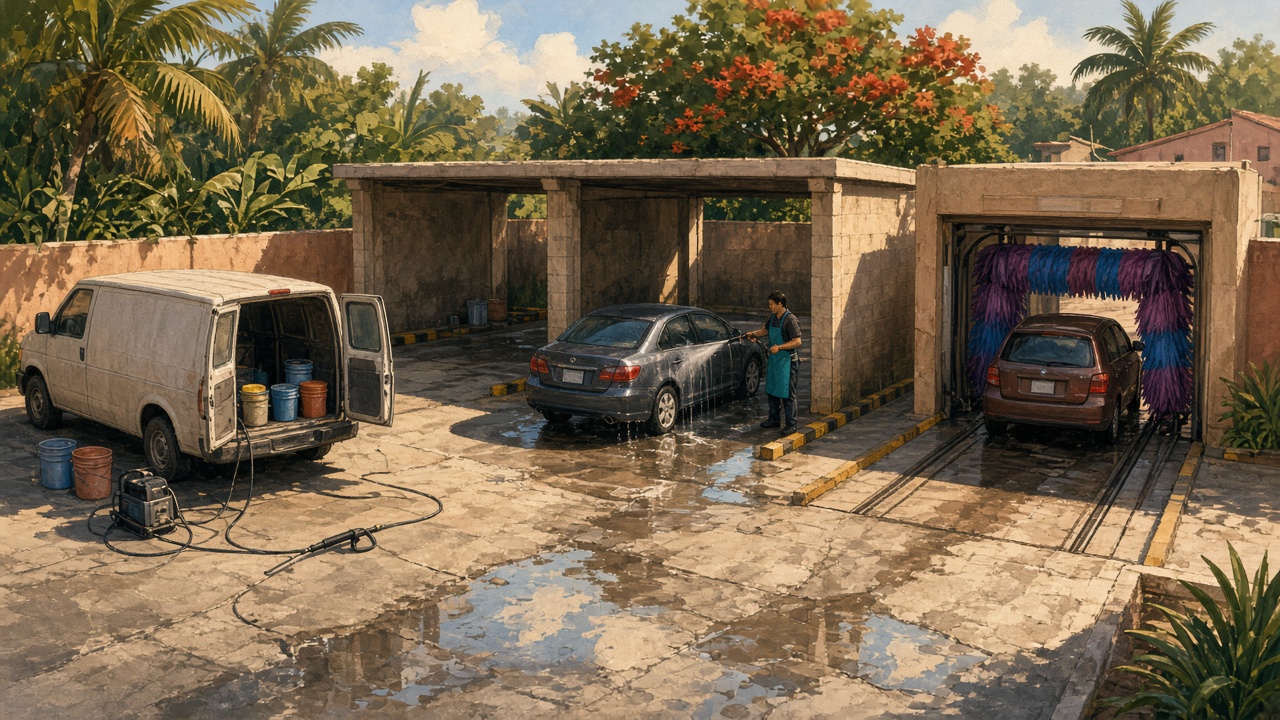
There is no single price. In Mexico, a mobile car wash can start with a few thousand pesos of basic gear; a fixed manual or express site usually moves through the hundreds of thousands and past a million pesos; and an automatic tunnel starts in the millions for machinery alone. The total depends on the site, the build-out, the permits, and working capital for the first months.
Brilloo is car wash software; we do not sell equipment or sites. Third-party figures were checked on 9 November 2026 and can change. Ranges marked as a Brilloo estimate are approximate, not a quote. This is not financial or legal advice.
Quick answer: three investment scenarios
The table collects what is published, without averaging it. One row is a Brilloo estimate (July 2026). Another is a third party that sells business plans or a savings pool. None of them is your local quote. This page is only about the money; the process lives in another guide.
The guide to opening your car wash (first 90 days) covers the site, paperwork, and the first weeks. This page answers what it costs.
| Type | Range | What it says is included | Source | How to read it |
|---|---|---|---|---|
| Manual (third party) | $180,000 – $400,000 MXN | 2 to 4 bays, vacuums, compressor, and cistern, per that page’s FAQ | Tandazo | Third party. Page updated 19 August 2026; re-read 9 November 2026. No purchase receipts. |
| Express (third party) | $500,000 – $1,200,000 MXN | Semi-automatic bays | Tandazo | Same page and the same caveats. Not an average with other sources. |
| “Complete” tunnel (third party, with caution) | $1,500,000 – $3,000,000 MXN | That page’s summary says arches, brushes, drying, and controls. The same article’s table lists the tunnel at a different range: $800,000 – $1,800,000 MXN | Tandazo | Treat it with caution. Both figures sit in the same article and clash with a manufacturer’s equipment-only price (below, in dollars). Do not use it as a quote. |
| “Complete” fixed site (third party) | $1,260,000 – $3,360,000 MXN | Deposit or rent, build-out, equipment, furniture, permits, launch ads, and working capital. Does not include buying the land. Data as of June 2025 | Modelos de plan de negocios | Third party that sells business plans. Article dated 14 August 2025; re-read 9 November 2026. Contrast, not your budget. |
| Manual or express (approximate Brilloo estimate) | $350,000 – $1,200,000 MXN | Order of magnitude for a fixed site in the opening guide. It does not itemize build-out or months of rent | Guía Brilloo | Our own approximate estimate (July 2026), not a quote or a market study. |
| Detailing (approximate Brilloo estimate) | $500,000 – $2,500,000 MXN | Same origin. Higher ticket and lower volume; not this page’s focus | Guía Brilloo | Our own approximate estimate. It keeps detailing from being mixed with a neighborhood hand wash. |
| Self-serve (approximate Brilloo estimate) | $800,000 – $3,500,000 MXN | Same origin. More infrastructure and less staff | Guía Brilloo | Our own approximate estimate. |
| Tunnel or conveyor, full project (approximate Brilloo estimate) | $3,000,000 – $15,000,000+ MXN | Total project investment, not the machine price. Build-out, land or rent, water, and a reserve explain why the ceiling is so wide | Guía Brilloo | Our own approximate estimate. Do not average it with the third party’s $1.5 to $3 million range. |
Checked 9 November 2026. We do not average these rows. Brilloo’s peso figures are an approximate estimate from our own guide, not a market survey.
Mobile fits someone who wants to learn the trade with little fixed capital. The risk is not rent: it is drive time, an uneven schedule, and a ticket that has to cover fuel and hours. A fixed manual or express site fits someone who already has (or can lease) a lot with traffic and a drain. The risk shifts from “can I afford the gear?” to “does traffic cover rent in the slow months?”. A tunnel fits someone who can tie up millions and count real cars. Without a traffic count and a break-even, new equipment only brings the loss forward.
If the question is franchise vs. independent, that comparison lives on another page: here the independent path is budgeted on its own. And before you project revenue, separate this investment from how much a car wash earns in Mexico.
Mobile car wash: the lowest way in
The minimum kit fits in a van: products, a portable vacuum, microfiber, and a polisher if you detail. The vehicle is separate. With no shop there is no rent and no floor work, and that is what keeps the entry low. In exchange you pay fuel, time between customers, and a schedule that falls apart in the rain or when the customer’s parking spot will not let you work.
We do not publish a chemical supplier’s “pro kit” price here. Those lists change, they usually leave out the van and working capital, and we did not reopen them as a store receipt for this guide. If someone offers to start you for a few thousand pesos, ask what is included and what is left in the account in month two.
Permits do not disappear either: at least a tax ID and, depending on the municipality, a notice to work on the street or in parking lots. There is no single fee we can cite with confidence for the mobile model, so we do not invent one. Fixed-site paperwork is in the opening guide; the mobile case is confirmed at your local office, not on a blog.
Even without a shop, online booking and a checkout ticket help from day one: the schedule stops living in chat and the cash stops living in a pocket.
Manual or express car wash (fixed site)
This is where search-result articles disagree, and they are right not to match: they are not measuring the same thing. Tandazo, updated 19 August 2026, publishes $180,000 to $400,000 MXN for a manual wash and $500,000 to $1,200,000 MXN for express. Modelos de plan de negocios, with data as of June 2025, publishes $1,260,000 to $3,360,000 MXN for a fixed site that already includes build-out, permits, and a fund. Brilloo’s approximate estimate for manual or express —$350,000 to $1,200,000 MXN— comes from our July 2026 guide. It is an order of magnitude, not a quote, and we do not average it with the others.
The gap is what is included. An “equipment and bays” range does not pay prepaid rent or the sludge trap. A “whole business” range already folded in months of cushion and, sometimes, furniture and a sign. If your sheet only has pressure washers, you are on the low row. If you already added build-out, deposits, and a reserve, you are closer to the high row. Neither row saves you from getting three quotes in your city.
Equipment: a third-party estimate, not a store price
We do not paste shelf prices for pressure washers or vacuums. They change by store and by week, and we did not reopen them as a receipt for this page. What is published, and what we re-read on 9 November 2026, is the equipment range from Modelos de plan de negocios (data as of June 2025). Use it for the order of magnitude, then quote continuous-duty models.
| Equipment | Published range | Notes |
|---|---|---|
| Basic manual equipment | $120,000 – $250,000 MXN | Pressure washers, vacuums, and tanks, per that site |
| Semi-automatic equipment | $350,000 – $800,000 MXN | Partial system and basic water reclaim |
| Fully automatic equipment | $800,000 – $2,250,000 MXN | Automated system and reclaim, in the same article |
| Industrial pressure washer (each) | $15,000 – $35,000 MXN | Third-party range, not a store price for one model |
| Industrial vacuum (each) | $8,000 – $18,000 MXN | Same: a published estimate, not a shelf receipt |
Source: Modelos de plan de negocios. Data as of June 2025; page re-read 9 November 2026. Not a store list.
Site, build-out, and drainage
The number that moves the most is not the pressure washer: it is the lot and what you have to do to the floor so water does not pool or leave untreated. These figures are from the same Modelos de plan de negocios article. They are a June 2025 estimate, not an appraisal.
| Item | Range | How to read it |
|---|---|---|
| Rent, about 500 m² in Mexico City | $35,000 – $60,000 MXN / mes | Modelos de plan de negocios, data as of June 2025. The same text says smaller cities can be lower, without another table. |
| Construction or fit-out | $230,000 – $600,000 MXN | Same source and date. Their $230k floor is the minimum they describe (drainage, water, and power). The ceiling adds a waiting room and office. |
| Buying ~500 m² in Mexico City (extra) | $4,000,000 – $6,000,000 MXN | Same source. Do not add it to the $1.26 to $3.36 million range: that range assumes you rent. |
| Permits and licenses (one third party) | $20,000 – $60,000 MXN | Modelos de plan de negocios, data as of June 2025. They say it covers the environmental license, operating license, zoning, civil protection, and SAT. |
| Environmental and municipal permits (another third party) | $15,000 – $80,000 MXN | Tandazo, updated 19 August 2026. It does not match the row above. There is no national fee: confirm it at your municipality. |
| Monthly water and power | $11,000 – $17,000 MXN | Modelos de plan de negocios, data as of June 2025. Their estimate for a fixed site, not your bill. |
| Monthly payroll | $25,000 – $80,000 MXN | Same source. They talk about roughly 5 to 10 roles. It is not a washer commission and not a wage Brilloo calculates. |
| Suggested contingency fund | $150,000 – $350,000 MXN | That third party’s suggestion: they present it as 3 to 6 months of operating costs. Adjust it with your real rent. |
Before you sign, calculate break-even with that rent. If the menu does not exist yet, build the pricing structure and the price by vehicle type first: an SUV does not cost the same as a sedan in water, time, or chemical.
Permits: a short budget, no single fee
The two permit ranges in the table ($20,000–$60,000 and $15,000–$80,000 MXN) do not match, and neither is a receipt from your municipality. We leave them side by side, with caution, so you do not copy just one. Confirm zoning, the operating license, and wastewater discharge at the local office. This is not legal or tax advice.
In practice the expensive permit is usually the environmental one, because of dirty water, not the sign. Time counts too: some filings take months, and rent can start first. The starter list (zoning, municipal license, tax registration) is in the guide to opening your car wash (first 90 days). We do not repeat it here, so this page does not turn into a permit manual.
Automatic wash tunnel: what the equipment actually costs
A wash tunnel in Mexico, in the basic configuration one manufacturer publishes, starts around 118 thousand dollars before VAT, with transport and installation included on that list. That amount is only the equipment: civil works, water treatment, permits, and working capital are still missing. Quote it before you sign the site. We leave the dollars as the source publishes them; we do not convert them to pesos.
| Published model | List price |
|---|---|
| Matik’s series, from | US$118,594.50 |
| MK7, from | US$131,298.00 |
| MK12, from | US$196,528.70 |
Source: GreenMatik wash tunnels. Checked 9 November 2026. The page says prices are indicative, in USD, before VAT, for Mexico, and include transport, import, and installation on the basic configuration. For the rest of Latin America the same text sells the equipment FOB and quotes freight, import, and installation separately. There are more base models on that page; we do not average them. One intermediate line used ambiguous punctuation and we did not copy it.
A touchless gantry is a different machine. GreenMatik publishes the AKUA series, at 12 to 15 vehicles per hour, on its touchless bridge page, with the same note of indicative USD prices before VAT. The dollar amount was not readable text when we reopened the page on 9 November 2026, so we do not cite it. Ask for the quote and do not add it to a brush tunnel as if it were the same concept. Other brands publish no price: those are quoted too, not guessed.
That is why the “complete tunnel” range of $1.5 to $3 million MXN (and the $800 thousand to $1.8 million line in the same article’s table) has to be read with caution. The installed machine, on the manufacturer’s list, already starts above 118 thousand dollars before VAT. Build-out, land or rent, water reclaim, and working capital are another layer. Brilloo’s approximate estimate for the full project —from $3 million to $15 million or more— tries to name that layer. It is still our estimate, not an audited stack of invoices.
A practical rule: do not open a tunnel without a car count and a break-even. If the worst month does not cover rent and payroll, newer equipment will not save you. Early profitability mistakes are usually about flow, not about the brush brand.
Where the money goes
Our opening guide splits the budget like this. It is a July 2026 proportion guide, not a cost study. If a spreadsheet leaves the reserve at zero, it is not a budget: it is a bet that you will be full in month one.
| Item | Rough % of the budget |
|---|---|
| Fit-out / civil works | 15% – 35% |
| Equipment (washers, vacuums, compressor, etc.) | 20% – 40% |
| Opening inventory | 5% – 10% |
| Deposits, prepaid rent, bonds | 10% – 20% |
| Permits, advisors, incorporation | 3% – 8% |
| Launch marketing and operating reserve | 10% – 15% |
Proportion estimate from the Brilloo guide (July 2026). Do not turn it into pesos by multiplying someone else’s range.
Working capital is the row people skip. Modelos de plan de negocios suggests, with data as of June 2025, a fund of $150,000 to $350,000 MXN and describes it as 3 to 6 months of operating costs. That is their suggestion. Your version comes from the rent, payroll, and water you already quoted, not from copying another city’s fund. Besides equipment, most budgets break on prepaid rent, drainage work, permits, and the first months with few cars.
Hidden costs that break the budget
These do not come with a figure of ours. Where a third party published a monthly range, it carries their name and date. The rest is a list of what to ask before you sign, not an invented surcharge.
- • Water at a commercial rate, not a household one, and the gap if the city requires treatment or water trucks.
- • Chemical and microfiber waste that is not on the equipment sheet.
- • Staff turnover: hiring, training, and days when you wash with fewer people.
- • Rain days when rent does not pause. Revenue does.
- • Pump, hose, and nozzle maintenance. A stopped machine is not in the purchase price.
- • A sludge trap or drain rebuilt because the first contractor left it “for later.”
For monthly operations, the same business-plan site estimates water and power at $11,000 to $17,000 MXN and payroll at $25,000 to $80,000 MXN (data as of June 2025, re-read 9 November 2026). Do not add them blindly to rent from another city. And do not confuse them with commissions: Brilloo calculates seller commissions only, not washer commissions, and it has no time clock.
How to build your own budget
Copy the structure, not the numbers. A sheet with empty cells —equipment, build-out, deposits, permits, inventory, reserve— is worth more than the average of three blogs. We do not publish a prefilled calculator: prefilling it would invent the average this page refuses to give.
1. Write the model in one line: mobile, manual, express, self-serve, or tunnel. Do not mix the machine price with the project price.
2. Quote 2 or 3 continuous-duty pressure washers from local dealers and keep the PDF. Do not copy a shelf price from a blog.
3. Ask for water and drainage feasibility before you sign the lease. A bad sludge trap gets paid for twice.
4. Get build quotes that name the floor, trench, grates, and water treatment, not just “fit-out.”
5. Set aside the deposit, prepaid rent, and a reserve of several months of fixed costs. One third party suggests 3 to 6 months; use your rent, not another city’s.
6. Build the menu (service, package, price by vehicle) and the break-even with the real rent, before you fall in love with the site.
7. Decide who takes payment and how the drawer is reconciled on day one. Software does not lower the rent; it does keep cash from leaking in the drawer.
Once the menu exists, measure it against what to charge for add-on services and against car wash key metrics. Projected revenue, kept separate from this investment, is in how much a car wash earns in Mexico.
Set up the operation before you open: try Brilloo free for 30 days, no card
The site and the equipment are the large spend. Cash control is the cheap line: POS, cash cut, cash vault, bookings, and loyalty.
How not to lose control of cash from day one
The large spend is the site and the equipment. Cash control is the cheapest line and the one that protects the most: it does not lower the rent and it does not pick the corner, but it keeps a good day from disappearing in the drawer. Brilloo is that layer, not the tunnel.
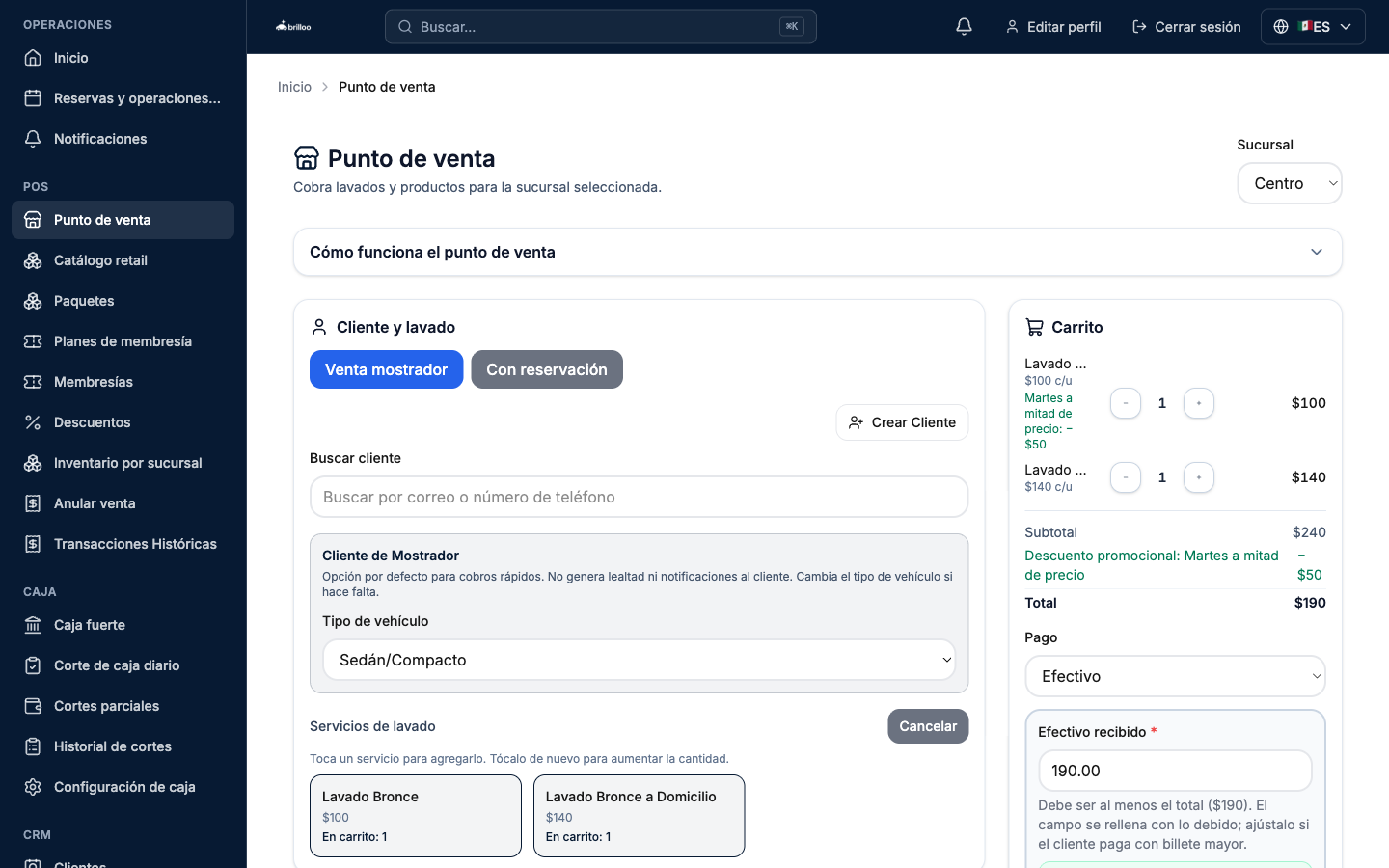
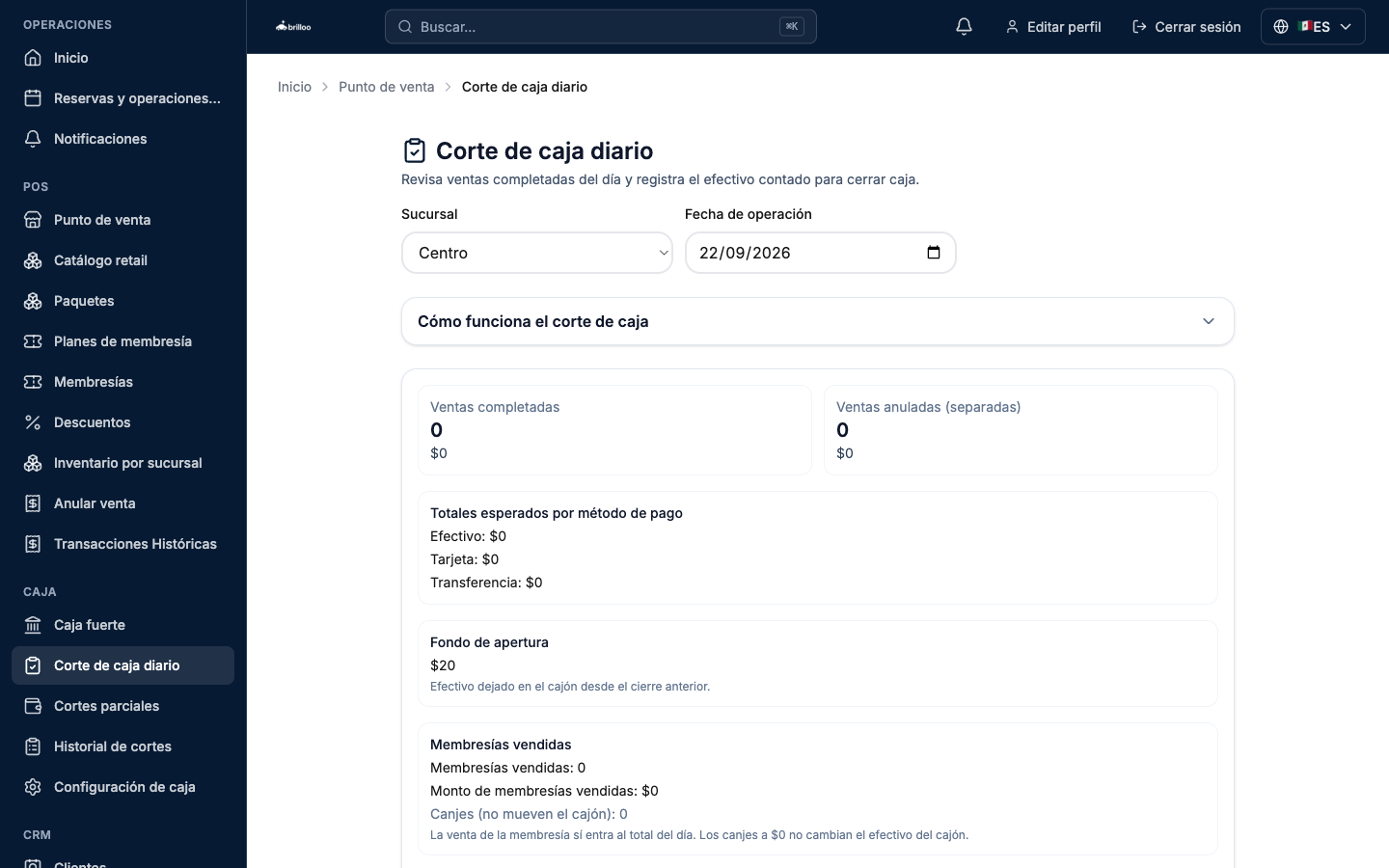
With Brilloo you can check out on a POS with promotions and packages, run the cash cut and partial cuts, keep the cash vault and bank deposits, sell memberships at the counter (no automatic monthly charge), track loyalty, publish the page and take bookings, ask for reviews, see AI reports, and run more than one branch. Commissions are for sellers, not for washers. The trial is 30 days and does not ask for a card.
What it does not do: it does not pick the site, file permits, issue CFDI invoices, or include a time clock. It does not capture license plates and it does not run the lot or the queue. It also does not calculate washer commissions.
If you want the cash piece before you decide, read the cash cut and partial cuts and the cash vault and bank deposits. If you are comparing tools, read how to choose car wash software. Product capabilities are on the features page and the plans are on pricing.
· ·
Frequently asked questions
How much does it cost to open a car wash in Mexico?
It depends on the model, and there is no national average. A mobile service can start with basic gear and no shop rent. A fixed manual or express site shows up in a 2026 source between $180,000 and $1,200,000 MXN depending on format, and Brilloo’s approximate estimate for that site runs from $350,000 to $1,200,000 MXN. A tunnel: one manufacturer lists the machine from US$118,594.50 before VAT; the full project is a different number. Use the tables and do not mix sources.
How much does a simple car wash cost to open?
A 2- to 4-bay manual wash appears on Tandazo, updated 19 August 2026, between $180,000 and $400,000 MXN. That page shows no purchase receipts. If you add build-out and a reserve, Brilloo’s approximate opening-guide estimate (July 2026) runs from $350,000 to $1,200,000 MXN. Get local quotes before you lock a number.
How much does an automatic wash tunnel cost?
GreenMatik lists the Matik’s series from US$118,594.50 and the MK12 from US$196,528.70, in dollars, before VAT, for Mexico, with transport, import, and installation on the basic configuration. Checked 9 November 2026. That is the machine, not the site or working capital. Do not convert it to pesos without that day’s exchange rate, and quote it with the manufacturer.
How much does a car wash permit cost?
There is no single national fee. One site, with data as of June 2025, publishes $20,000 to $60,000 MXN. Another, updated in August 2026, publishes $15,000 to $80,000 MXN for environmental and municipal permits. Those are third-party estimates, not a receipt. Confirm the amount at your local office. This is not legal advice.
Which is cheaper, mobile or a fixed site?
Mobile needs less startup capital: you skip rent and drainage works, and you take on fuel, drive time, and a schedule instead. A fixed site can serve more cars when there is traffic and a drain, which is why the budget moves into the hundreds of thousands of pesos or more. The cheaper opening is not always the better cash flow.
What should I budget besides equipment?
A deposit and months of rent, floor and drainage work (including the sludge trap), permits, supplies, signage, and a reserve for fixed costs. One third party, with data as of June 2025, suggests a fund of $150,000 to $350,000 MXN and presents it as 3 to 6 months of operations. If your sheet has no working capital, you do not have a budget.
Conclusion
Opening a car wash in Mexico does not have a fixed price: a mobile model can start with a few thousand pesos of gear; a fixed manual or express site usually needs hundreds of thousands or more than a million once you add the site, the build-out, and a reserve; and a tunnel means millions in machinery alone. Also budget permits and several months of fixed costs. Keep the row whose source you understood, and drop the average.
Read next: the guide to opening your car wash (first 90 days), franchise vs. independent if you are still comparing paths, and how much a car wash earns in Mexico when you want to move from investment to revenue.
Set up the operation before you open: try Brilloo free for 30 days, no card
The site and the equipment are the large spend. Cash control is the cheap line: POS, cash cut, cash vault, bookings, and loyalty.
Software for car washes in Mexico and Latin America. Point of sale, cash, and bookings. We do not sell equipment, sites, or franchises. This guide is not financial or legal advice.