How to Train a New Car Wash Attendant: First Week, Handoff Checklist, and Safety
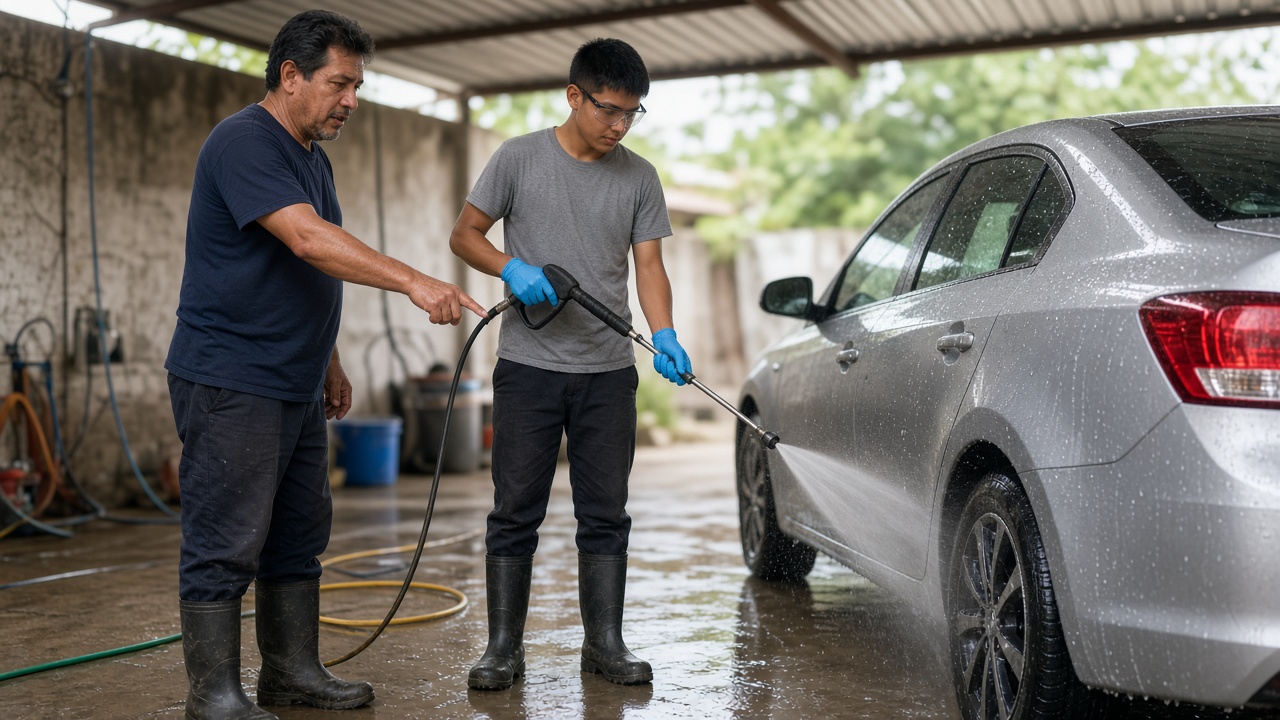
To train a new car wash attendant, put your wash method in writing, teach safety on day one, and have them watch a teammate before washing alongside one. Every car gets an intake check and a handoff check. They are ready when quality and safety hold up without constant supervision.
Brilloo is car wash software; it is not a trade school or legal or occupational-safety advice. Official Mexican standards were checked in November 2026 and may change. Check the standard in force and your products’ safety data sheets before you apply them.
Quick answer: how you train them (and when they are ready)
To train a new car wash attendant, put your wash method in writing, teach safety on day one, and have them watch a teammate before washing alongside one. Every car should get an intake check and a handoff check. They are ready when they meet that standard on a basic wash, not when it “just feels like they have got it.”
They are ready for a basic wash when they pass the handoff checklist, follow safety without a reminder, and report damage at once. There is no average number of days. If they already know the trade, shorten the watching; do not rush it because you are short-staffed.
Day one does not include working alone, or polishing, engine cleaning, or upholstery. Those services are taught later, one at a time and with a trainer, once the basic wash is consistently right.
Before they arrive: the method in writing
If everyone washes differently, the new person copies that shortcut. Leave the order in sight, the dilution in milliliters (not “a splash”), which tools never cross, and who to tell. Wheels and paint do not share a towel or a bucket.
That sheet says what each package includes. The attendant delivers what was charged, not what “we usually throw in.” The menu is not redefined here.
The price of add-ons — polish, engine bay, upholstery, wax — lives in what to charge for add-on services, and those jobs are taught after the basic wash. Combos are built in point-of-sale packages and combos, and the day’s offer in promotions that do not give away margin. What a membership covers at the wash is in how to launch a membership plan: it is sold at the counter and is not charged automatically each month. If you are still building the menu, the pricing structure for services, packages, and memberships is the place for that.
Pick the trainer and have protective equipment ready for the job’s risk. Collect the safety data sheets and mark the chemical area and the wet-floor area. Day one does not include polish, engine bay, or upholstery.
In the first months, the first-90-days guide covers the opening team. Letting the new person work alone because Saturday filled up is one of the mistakes that eat profit.
The first week, day by day
A guide for a fixed manual or express car wash, written with Mexico in mind and useful elsewhere in Latin America. Adjust it if they already know the trade. Do not shorten it because you are short-staffed.
- Day 1 — watch and safety before touching a car: chemicals, protective equipment, the pressure washer, wet floors and, if you move cars, that task. Walk the site and who to tell. Explain pay (wage, tips, or your arrangement): not a per-car commission; how much to pay is separate. They learn the ticket — service, package, promotion, or membership — without charging. They watch a cycle, help vacuum or dry, and see intake.
- Days 2 and 3 — parts of the wash. Wheels, vacuuming, and drying, with the trainer on each, plus both checklists. Still no polishing, engine bay, or upholstery. If you move customers’ cars, repeat it slowly beside the trainer; this guide does not turn that into a house rule.
- Days 4 and 5 — a basic wash alongside someone, with no delicate add-ons. Every car goes through the handoff checklist with the trainer. Correct with a specific instruction (“do not use the same towel on wheels and paint”), never with “do it better.”
- After week 1. Basic washes only, once the handoff checklist is met consistently and safety no longer depends on a reminder. Polishing, engine cleaning, and upholstery come later, one at a time and with a trainer. A 10 to 15 minute review once a week, on a repeated mistake or a recent review, fixes the method without putting the person on display.
Knowing what was charged does not require them to be the cashier. In a car wash point of sale the owner and the manager set up the catalog and counter staff take payment. The attendant only needs the ticket: service, package, promotion, or membership.
Intake checklist (before the car gets wet)
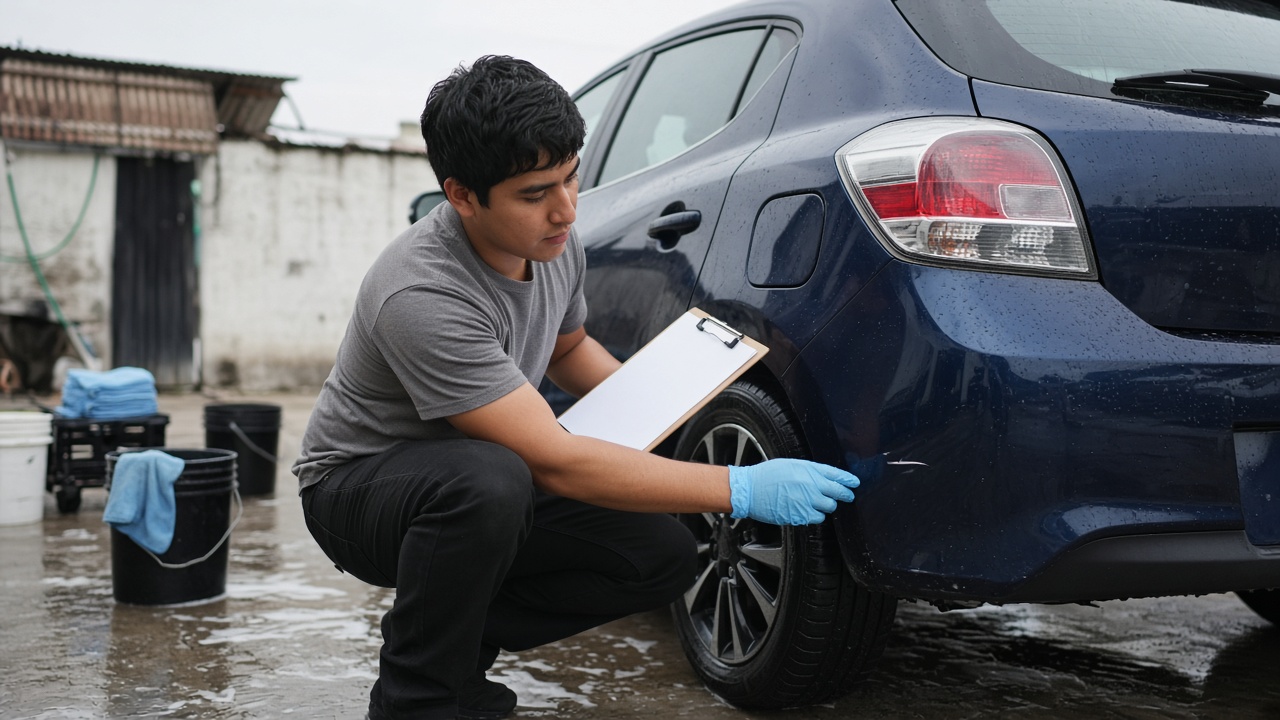
It prevents a complaint about damage the car already had. The new attendant looks, notes it, and reports it before the car gets wet. The record can be a sheet, the shop’s photos, or the note you already use.
- Visible damage: scratches, dents, lights, mirrors, and rims. The new attendant learns to look and to report, not to argue with the customer.
- Delicate accessories (antenna, spoiler, sensors, trim) and the condition of the upholstery before vacuuming or getting it wet.
- Belongings in sight. If something matters, tell the customer or the supervisor before you start.
- Special requests and which service was charged: a single service, a package, the day’s promotion, or what the membership includes.
- The record can be a sheet, photos the shop already takes, or the note the business already uses. What matters is reporting it before the car gets wet.
Handoff checklist (before you give the car back)
Before handing the car back, check the wheels and rims (including behind the spokes), glass and mirrors free of water spots, door jambs and trunk dry, the interior vacuumed, mats in place, and the customer’s belongings where they were. If a defect would be obvious in the first few seconds, do not hand the car over: fix it first.
Each point is a yes or a no. If it would show when the door opens — windshield haze, a spot on the hood, a crooked mat, a wet jamb — do not call them: fix it.
- Wheels and rims clean, including behind the spokes.
- Paint, glass, and mirrors free of water spots.
- Door jambs, sills, and the trunk dry.
- Interior vacuumed; dash and consoles free of product residue; screens and controls free of a chemical that does not belong on them.
- Mats in place; nothing of the customer’s out of place; no shop towels, brushes, or spray guns left inside.
- The service that was charged — and only that service — is done. If an add-on was offered, it was recorded at the counter.
- If the service wet the interior: a moment with the doors closed, to smell for dampness before you hand the car back.
The service that was charged is done, and an add-on that was not recorded is not given away. If they asked for something else beside the car, it goes back to the counter before you hand it over.
Run your operation while you train the team: try Brilloo free for 30 days, no credit card
The floor method (order, checklists, and safety) is yours to teach. The software helps the team see what was charged and helps you see, in reviews and reports, where to coach.
Day-one safety (not optional)
Teach safety before anyone touches the first car: do not mix chemicals, wear the protective equipment the safety data sheet calls for, never point the pressure washer at people, and watch your step on wet floors. If you have to move a customer’s car, look around, go slowly, and leave their belongings alone. Report any damage right away; never hide it.
Practical guidance, not legal or occupational-safety advice. The standards were read in the Official Gazette on 16 November 2026 and can change. Match each product to its safety data sheet.
Chemicals and safety data sheets
Do not mix different products. Diluting means product plus water. Do not “boost” a shampoo with another one. Measure with a jug, in milliliters. Label the name, the ratio, and the date. Do not reuse drink bottles. Store it closed, out of the sun and out of the walkway. Read the label and the safety data sheet before a new product. Wash your hands before you eat, drink, or smoke.
NOM-018-STPS-2015, published in the Mexican Official Gazette on 9 October 2015, applies to workplaces that handle hazardous chemical substances. Its duties also cover hazardous mixtures. Do not write that every car-wash shampoo or wax falls under this standard: that is what the product’s safety data sheet says, not this page. If the sheet classifies the product as hazardous, the employer keeps the safety data sheet in Spanish, with labeling and signage, and trains the people who handle it at least once a year, each time a new hazardous substance or mixture is added, and when the sheet or the signage is updated. This is not legal advice.
Personal protective equipment
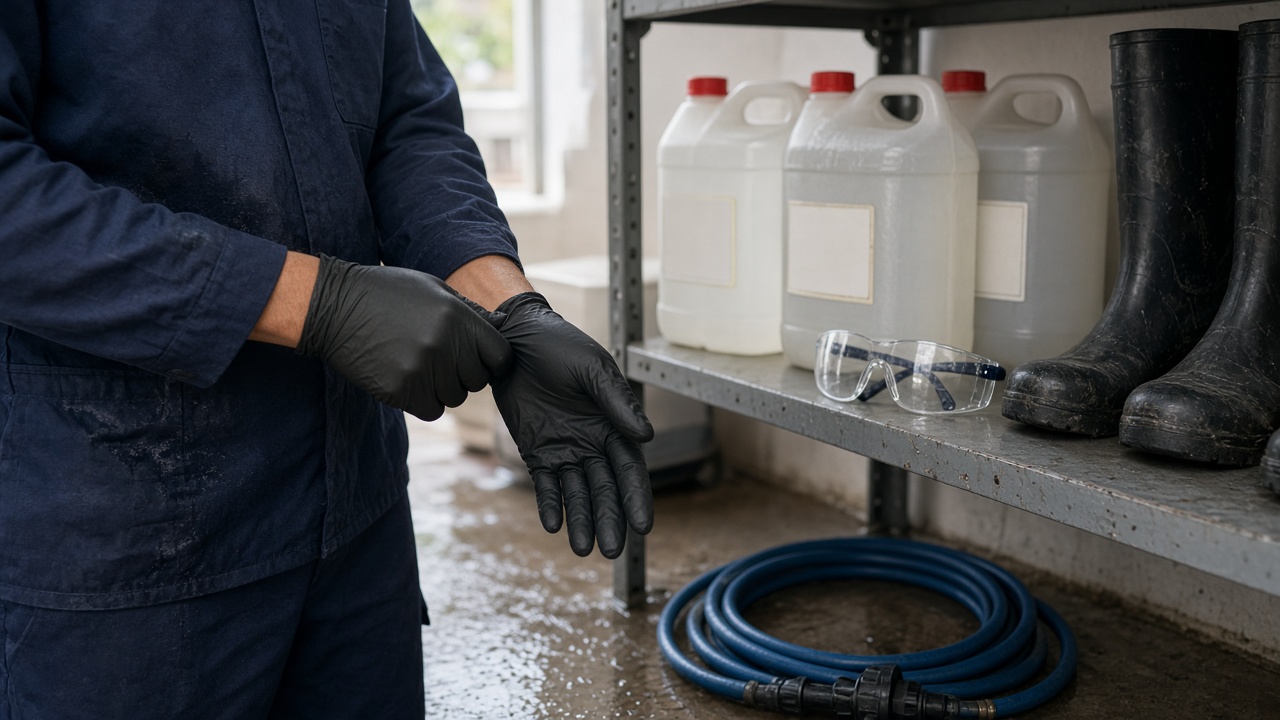
The employer identifies the risk, provides the equipment, and teaches how to use, check, and replace it. The attendant wears it and says so when it no longer protects them. Depending on the site and the safety data sheet, that is often eye protection, gloves compatible with the chemical, and footwear for wet floors. It is not a fixed list.
NOM-017-STPS-2024, on personal protective equipment, was published in the Mexican Official Gazette on 28 March 2025 and takes effect six months later, on 28 September 2025. From that date, NOM-017-STPS-2008 is without effect: do not cite it as if it were still in force. The 2024 standard applies in workplaces where protective equipment is required. New hires receive theory and practical training before they start work. It is reinforced at least every two years, or sooner if the equipment or the conditions that affect its use change, and a record is kept. Areas where it is mandatory are signed; the standard itself points to NOM-026-STPS-2008 for that signage. This is not legal advice.
Pressure washer and equipment
Do not aim at people, animals, or the public street. Distance and pressure come from the manufacturer. Do not put the nozzle on paint, seals, the engine, or the interior. Keep cords away from water; do not use damaged equipment. Vacuum and blower, with dry connections. No pressure figures here: use the manual.
Wet floors, hoses, and falls
Suitable footwear, no running, puddles picked up where people walk, and hoses and cords out of the path. Sign the wet floor when it applies. This is practical advice: we do not cite a floor standard because we did not verify a specific section while writing this.
Moving a customer’s car
If the car has to be moved, this is practical guidance, not a house rule and not a legal requirement from this page. Look around, adjust the seat, mirrors, and transmission, go slowly, do not touch the radio, GPS, or belongings, and do not leave it running and unattended. If the transmission, the size, or the sensors do not feel safe, ask for help. Report a bump right away.
If they scratch or damage something
Tell the supervisor at the moment. Hiding it turns a repair into a complaint, and reporting it is not punished. If the customer posts later, how to get and manage reviews explains the reply.
How to know what the customer bought (and how to improve from what they say)
Training is a floor method: order, checklists, and safety. Software does not replace the trainer. It helps you see what was sold and, in reviews and reports, what to reinforce.
The point of sale shows what was charged at the counter, and the attendant delivers it without being the cashier. Reviews (invitation, rating, comment, and photos) feed the coaching, not a wall of blame: How to get and manage reviews explains it. Car wash key metrics show complaints over time. The AI executive report summarizes the month; it does not evaluate the attendant.
Brilloo does not calculate or promise commissions for attendants, and it does not assign an attendant to a ticket or a reservation. Memberships are sold at the counter; they are not charged automatically each month. The trial is 30 days and does not ask for a card.
If you are comparing tools, read how to choose car wash software. Product capabilities are on the features page and the plans are on pricing. To try it: 30 days, no card.
Frequently asked questions
How do you train a new car wash attendant?
With the wash method in writing, a first day of safety and observation, practice on parts of the wash, and then a full basic wash alongside a trainer. Every car gets an intake check and a handoff check. Delicate add-ons, such as polishing, engine cleaning, or upholstery, are taught later, one at a time, with a trainer. The point of that week is that quality and safety hold up, not that it “just feels like they have got it.”
How long does a new attendant take to learn?
It depends on their experience and the services you offer. There is no single number of days and no average that fits everyone. They are ready for a basic wash when they pass the handoff checklist, follow safety without a reminder, and report damage immediately. Add-ons are signed off separately, one at a time, with a trainer. If they already know the trade, shorten the watching; do not rush it because you are short-staffed.
What do you teach first?
Safety, before anyone touches the first car: chemicals, protective equipment, the pressure washer, wet floors, and, if your shop moves customers’ cars, how to do that carefully. Also the wash order, and what to do if they scratch or damage something: tell the person you named, right away. Day one is for watching a full cycle and helping with simple tasks, such as vacuuming or drying. They do not work alone.
What should you check before handing the car back?
Wheels and rims, including behind the spokes; glass, mirrors, and paint free of water spots; door jambs, sills, and the trunk dry; the interior vacuumed; dash and consoles free of product residue; mats in place and the customer’s belongings where they were. No shop towels or spray guns left inside. If a defect would show when the door opens, or in the first few seconds, fix it before you call the customer.
When do you teach polishing, engine cleaning, or upholstery?
After the basic wash consistently meets the standard: the handoff checklist passes and safety no longer depends on a reminder. Those services carry more risk for the paint, the engine, or the interior. They are learned alongside a trainer, one at a time, with the product and the dilution you wrote down in milliliters. They are not day-one work.
Should you explain pay on day one?
Yes. They should know how your business pays them — a wage, tips, or another arrangement you actually use — so there are no misunderstandings. That does not mean a per-car commission or a software feature. How much to pay a washer is a separate topic, and this guide does not settle it. December aguinaldo is also separate: it has its own guide. On day one, explain the arrangement that already runs in your shop.
Conclusion
Close on the method: the sheet, week one, two checklists, and day-one safety. They are ready when quality and safety hold on their own. The person sets the time, not an average.
Read next: the first-90-days guide if you are building the opening team, 2026 aguinaldo for car wash attendants if the question is the December benefit, how to get and manage reviews for the weekly review, and the car wash point of sale if the question is the counter and not the wash.
Run your operation while you train the team: try Brilloo free for 30 days, no credit card
The floor method (order, checklists, and safety) is yours to teach. The software helps the team see what was charged and helps you see, in reviews and reports, where to coach.
Software for car washes in Mexico and Latin America. This guide is a floor method for an attendant’s first week, not a trade course or legal or occupational-safety advice.